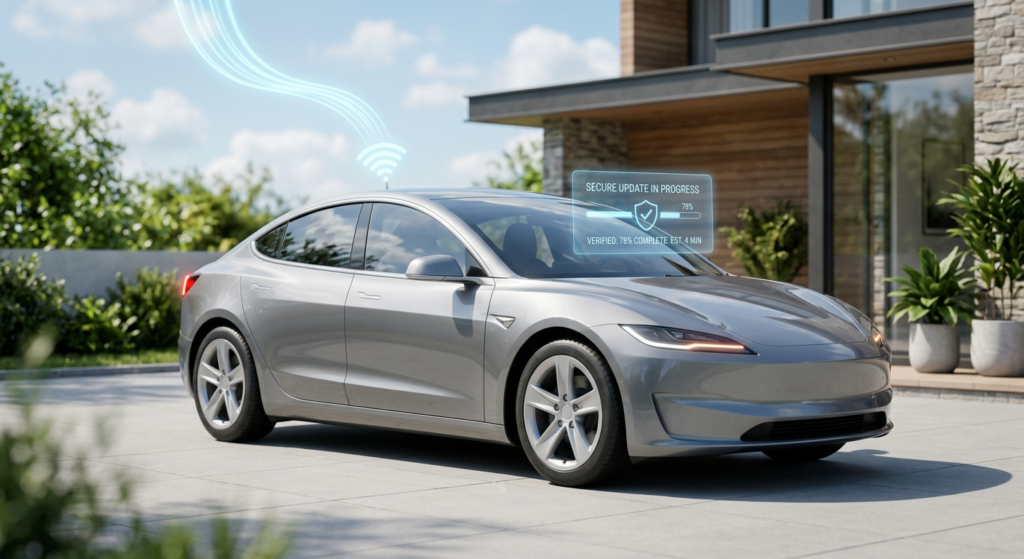
Over-the-air software updates have become one of the most valuable capabilities in the modern vehicle industry. Manufacturers can fix safety issues, improve performance and roll out new features to vehicles already on the road – no workshop visit, no physical recall, no inconvenience to the driver. For the industry, OTA reduces cost and complexity. For drivers, it means the car they own can be better than the one that left the factory.
The direction of travel is clear. OTA is not a risk to be managed but a capability to be got right.
Building a trustworthy approach
It takes more than robust cybersecurity to be trustworthy. Cybersecurity is the foundation: no update process can be trusted if it can be tampered with, but a hardened wireless link is only part of the picture. A trustworthy OTA capability has to account for everything that can go wrong between the moment an update is authorized and the moment the vehicle drives away running it. And most of what goes wrong is not malicious at all: corrupted transfers, incomplete downloads and timing issues are the mundane failures of a complex delivery chain, and they can be every bit as consequential as an attack.
Technical OTA mechanisms
At its simplest, an OTA update is a software package travelling from a manufacturer’s systems to a vehicle over a network. Adding cybersecurity to that journey means being able to answer three basic questions with confidence: i) did the update come from where it says it comes from, ii) did it reach its intended destination, and iii) did it arrive exactly the same as intended?
These are the classic assurances of authentication, delivery and integrity, and they are well understood in general-purpose technology – signed packages, encrypted channels and secure hashes all exist to answer them. But answering them all at once, at the point of despatch, is not the same as answering them at every point along a delivery chain that runs through cloud infrastructure, network operators, telematics gateways and Tier 1 supplier integrations, each managed differently and each with its own security practices. A chain is only as strong as its weakest link.
Beyond the wireless link
In the automotive industry, OTA mechanisms have to do more than package delivery. A smartphone that fails an update can simply retry; a vehicle is a safety-critical system that may be parked with marginal connectivity, running on battery power, or needed at short notice. So, there is a fourth basic question, and it is the one that distinguishes automotive OTA from everything else: iv) was the update successfully installed as intended, including any contingencies?
Contingencies are where trust is really earned. What happens if power is lost mid-installation? If the download stalls at 95 per cent? If the new software fails its first self-check? A trustworthy OTA system knows the answers in advance: it can pause safely, resume cleanly, roll back to a known-good state and prove which software version is actually running. Contingencies also reach across systems. An update to the braking controls may rely on a matching version running in the steering controls, so both have to be delivered together or not at all. Every automaker recognizes the problem, and a trustworthy OTA system has to manage those dependencies, treating a multi-part update as a single co-ordinated event, and rolling it back as one if any part fails.
Beyond the technical OTA mechanisms
Even a technically flawless pipeline does not complete the picture, because OTA adds burdens that reach well beyond the wireless link. Software development has to treat updateability as a design requirement from the outset, not a feature bolted on at the end. This means the team structure also has to change with it. The usual OEM pattern – a development team builds the vehicle, hands it to production and disperses onto the next program – leaves no one owning the vehicle across its lifecycle. OTA gives that team both a reason and a mechanism to stay with it, continuing to develop and improve the software long after the vehicle has left the factory.
Verification processes must extend beyond the bench: an update validated in the laboratory still has to be proven against the enormous variety of hardware configurations, software versions and vehicle states it will meet in the field. And customer communications become part of the safety case – drivers need to know what an update does, when it will happen, what the vehicle will and will not do while it installs, and who to contact if something looks wrong. Trust, once lost through a badly handled update, is very hard to win back.
Where eSync fits
No single manufacturer can impose this discipline across a supply chain spanning dozens of platforms, hundreds of suppliers and millions of vehicles – which is the structural argument for
standardization. The eSync Alliance specifications define the common pipeline on which trustworthy OTA can be built consistently. Standardized protocols for update campaign management, payload delivery, verification and installation reporting mean that every node in the delivery chain works to the same definition of a valid, verified, successfully installed update, regardless of platform, manufacturer or supplier relationship. This also provides the auditable basis that regulators increasingly expect. Under UNECE WP.29/R156, manufacturers must demonstrate governance of their software update processes, and a standardized, documented pipeline built on open specifications is what makes that demonstration possible in practice.
OTA updates are too important to the future of the vehicle industry to be left to inconsistent implementation. The capability is proven. The task now is building the common infrastructure that makes it trustworthy at scale – and that is precisely what open standards exist to do.





![eSyncCES2025_Edit[33]](https://esyncalliance.org/wp-content/uploads/2025/01/eSyncCES2025_Edit33.png)